According to the latest report from TrendForce, although the overall economic situation did not improve significantly in the third quarter of 2024, factors such as the release of new smartphones and PC/laptops in the second half of the year driving supply chain stocking, coupled with continued strong demand for high-performance computing (HPC) related to artificial intelligence (AI) servers, have led to an improvement in overall wafer foundry capacity utilization compared to the second quarter.
In the third quarter, the total revenue of the world's top ten wafer foundries increased by 9.1% month on month, reaching $34.9 billion. Part of the growth is attributed to the significant contribution of high priced 3nm processes, breaking the record set during the pandemic.
Looking ahead to the fourth quarter of 2024, TrendForce predicts that advanced processes will still drive revenue for the top ten wafer foundries, but the quarterly growth rate is expected to slightly narrow. The expected operational performance is polarized, with AI and flagship smartphone/PC main chips expected to maintain demand for 5nm/4nm and 3nm processes until the end of the year, while CoWoS advanced packaging continues to face supply shortages.
Mature processes above 28nm, uncertain terminal sales, approaching traditional first quarter sales off-season in 2025, and significant decline in demand for peripheral ICs such as TV SoCs, LDDIs, and panel related PMICs due to inventory accumulation in the third quarter of 2024 are expected to suppress demand.
However, these negative factors may be offset by the surge in shipments of Chinese smartphone brands at the end of the year, as well as the urgent supply chain activities stimulated by China's trade in subsidies. Therefore, it is expected that the utilization rate of mature process capacity in the fourth quarter will remain the same or slightly increase compared to the previous quarter.
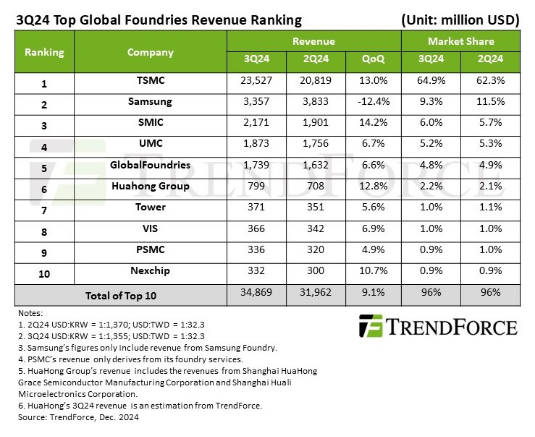
TrendForce The report shows that the revenue ranking of the top ten wafer foundries remained unchanged in the third quarter, with TSMC maintaining its leading position with nearly 65% market share. Flagship smartphone products AI GPU At the same time as the launch of the new PC CPU, TSMC's capacity utilization and wafer shipments increased, resulting in a 13% month on month increase in revenue to $23.53 billion.
Samsung's foundry maintained its position as the second largest semiconductor foundry in terms of revenue in the third quarter. Despite receiving some orders related to smartphones, the company's advanced technology customers' products are approaching the end of their lifecycle. In addition, intensified competition from Chinese peers in mature processes has led to price concessions, resulting in a 12.4% month on month decrease in revenue and a 9.3% market share.
SMIC, ranked third in revenue, did not see a significant increase in wafer shipments in the third quarter. But benefiting from the optimization of product structure and the release of 12 inch production capacity, sales increased by 14.2% month on month to $2.2 billion.
Ranked fourth, UMC saw improvements in wafer shipments and capacity utilization compared to the previous quarter, with revenue increasing by 6.7% month on month to $1.87 billion.
GF, ranked fifth, benefited from new machine and PC peripheral IC stocking orders, with increased wafer shipments and capacity utilization, resulting in a 6.6% month on month increase in revenue to $1.74 billion.
Consumer stocking drives urgent orders for peripheral components, improving the utilization rate of production capacity in second tier wafer foundries
Huahong Group has received orders for new machines and PC peripheral ICs, coupled with the demand for consumer replenishment, which has driven the increase in production capacity utilization of its subsidiaries Huali Microelectronics and Huahong Hongli. The overall revenue of the group increased by 12.8% in the quarter, with a market share of 2.2%, ranking sixth.
Tower, ranked seventh in the third quarter, benefited from orders for SiGe basic components required for smartphone peripheral RF ICs, optical communication SiPho, and AI servers, resulting in increased capacity utilization and a revenue increase of 5.6% to $371 million in the quarter.
The eighth ranked world advanced (VIS) benefits from consumer LDDI, panel/smartphone PMIC AI The related MOSFET orders, capacity utilization, and wafer shipments have all increased, with revenue increasing by 6.9% quarterly to $366 million.
Ranked ninth, TSMC's storage outsourcing production has steadily increased, and its logic business has received urgent orders for smartphone peripheral components, with third quarter revenue reaching $336 million.
Nexchip maintained its tenth position with a third quarter revenue of $332 million, representing a 10.7% quarterly increase.